How Do You Choose a Container Type for Shanghai Exports?
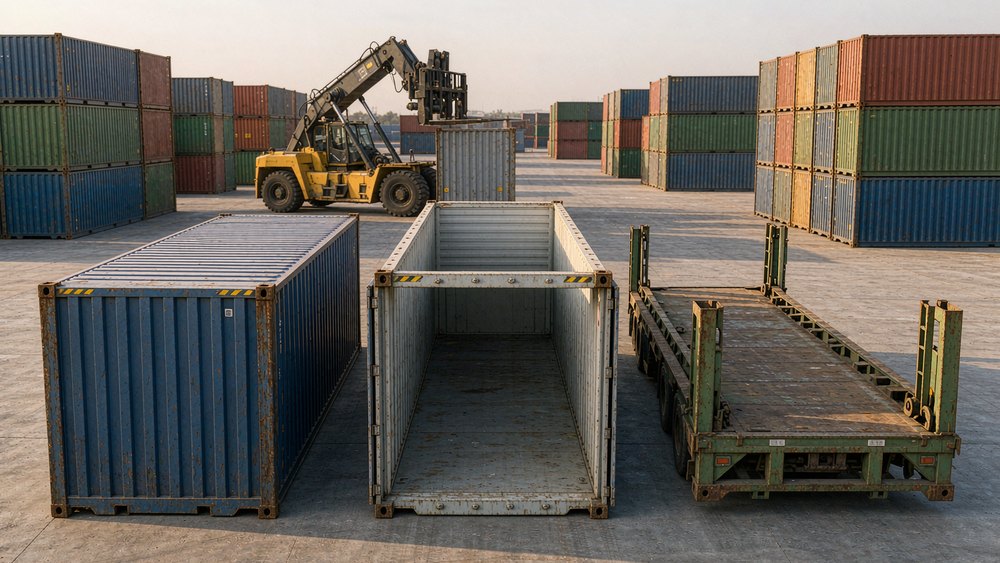
Choosing the wrong container type rarely shows up at booking. It shows up on loading day: the cargo will not fit, the gross weight turns out to be over the limit and the box is refused, or half the internal volume is thrown away trying to force everything in. Choosing a container is not a question of using whichever box happens to be available. It starts from three figures - total weight, total volume, and individual piece dimensions with centre of gravity - and then takes in the trade lane, the equipment at destination and the inland leg. This article covers general selection logic, stowage method and a checking list only; specific equipment availability, weight and dimension limits and related requirements follow the carrier, the shipping line and the load port at the time.
1. Three Figures to Calculate Before Choosing a Container
Whatever the cargo, calculate three figures before discussing container type. First, total weight: not the net weight of the goods but that plus packaging, pallets, securing material and dunnage - palletised cargo frequently stalls at the last step because the pallet weight itself was left out. Second, total volume: accumulate the outer carton dimensions, not the dimensions of the goods themselves, and allow for the gaps left by stacking. Third, piece dimensions and centre of gravity: whether anything is over-length, over-width or over-height, whether the cargo can be turned, and where the weight sits - these three points decide directly whether special equipment needs to be considered at all. The most common mistake in practice is getting the order the wrong way round: asking whether a forty-foot container is available, and then working out how to make the cargo fit. The right order is to calculate accurately first, judge which type satisfies both weight and volume, and only then verify the actual specification of the equipment being booked. Estimating from volume alone without checking weight against limits is the single most frequent trap in dense cargo exports.
2. Dry Containers: How the 20GP, 40GP and 40HQ Divide
Standard dry containers are the default for most export cargo, and the difference between them lies mainly in how volume and weight capacity are balanced. The 20GP has a clearly smaller internal volume but, relative to that volume, a more generous weight capacity; it suits steel, stone, ceramics and machinery components, cargo that does not take much space but weighs a great deal. Filling a 20GP with bulky light cargo usually means the box is full while the weight is nowhere near the limit, which is paying for capacity twice. The 40GP offers roughly twice the volume and suits cargo that occupies space without being heavy, while the 40HQ is taller again with a larger volume, which suits palletised cargo stacked several layers high. In one sentence: choosing a container is fundamentally about matching weight against volume - dense cargo goes into a smaller box, bulky light cargo into a larger one. Note too that weight limits and internal dimensions for nominally identical equipment differ between carriers, so whether cargo will fit should be judged from the booked specification rather than a remembered standard figure.
3. Overweight and Oversize: Where Open Top, Flat Rack and Platform Containers Apply
Special equipment comes into play only when the cargo will not obey the rules of a dry container. Overweight first: if the gross weight of a packed container exceeds the limit on the trade lane, at the load port or on the inland road network at destination, the box may fit while the route does not, and the answer is to split the shipment, use more than one container or move to a type whose weight capacity better fits. Many countries apply strict gross-weight limits on inland roads, and the trucking leg at destination is the one most often overlooked. Oversize next: open top containers take cargo taller than the internal height of a dry box that has to be lifted in from above; flat racks take over-width and over-height heavy machinery that needs side loading; platform containers are for the largest pieces that even a flat rack cannot handle. The defining feature of special equipment is that it must be requested in advance: the carrier has to approve it, space and stowage carry additional restrictions, and some trades or vessel types do not accept out-of-gauge cargo at all. Raising the need for special equipment on loading day usually means no equipment, or a forced change of plan, with time and cost to be recalculated.
4. Stowage Logic for Dense and Bulky Cargo
One plain rule governs loading: heavy cargo low, light cargo high, with the centre of gravity as low as possible and near the middle of the box. Around that rule, utilisation is the key measure of whether the container choice was sound. Bulky light cargo tends to fill the box without approaching the weight limit, meaning the container is too large or the load needs mixing; dense cargo tends to reach the weight limit with space to spare, meaning the same. Estimating utilisation roughly before loading lets you judge at booking stage which type to take, whether to split the shipment and whether to combine dense and bulky goods in one booking. Mixing does raise utilisation, but two points need attention: discharge order, so that cargo coming out first is stowed near the doors, and the practicality of de-stuffing at destination, since an over-complicated mix adds time and damage risk. Higher utilisation is not automatically better; using the space fully while keeping the load safe and dischargeable is what counts as the right choice.
5. Requesting Special Equipment: Limits and Support
Special equipment moves forward on four confirmations at once. First, lead time: raise it at booking stage and leave room for carrier approval and for a change of plan if it is declined; the later it is raised, the more likely there is no equipment. Second, port and lifting conditions: whether the load port and destination port have the lifting gear and yard space to handle it, since not every port can take out-of-gauge cargo. Third, inland support: open top and flat rack containers usually need dedicated trucking and a crane at destination, and the inland leg has to be confirmed at the same time, otherwise the cargo arrives by sea and cannot move by road. Fourth, carrier and trade restrictions: some trades and vessel types set hard limits on out-of-gauge dimensions, or decline them outright. If any one of the four is unconfirmed, the booking is not complete.
6. Stowage and Securing Inside the Container
Once the type is fixed, the quality of loading decides whether the cargo arrives intact. Five points. Arrange the load heavy low and light high, and large below small, so nothing heavy rests on light or precision cargo. Control horizontal movement with timber, bracing, lashing and airbags, filling the void at the doors in particular. Load in discharge order, so cargo coming out first is placed by the doors, which shortens de-stuffing considerably. Keep the centre of gravity low and central so lifting and inland transport stay safe. And keep a loading record, with photographs of the doors, the internal securing and the marks, together with the piece-by-piece count. None of these five is optional: if damage is found at destination and there is no loading record, the evidence for a claim is very hard to make stand up.
7. Five Recurring Mistakes
Five mistakes come round repeatedly. First, checking volume without checking weight, so the cargo fits by volume while the gross weight has already reached a container or road limit. Second, leaving packaging and pallets out of the calculation, when pallets consume both volume and weight and dozens of them are neither small nor light. Third, relying on the previous shipment as precedent, when piece sizes, packaging and stacking change between lots, so each booking deserves its own calculation. Fourth, requesting special equipment on loading day, where no equipment, a refusal or a forced change costs far more than the earlier conversation would have. Fifth, ignoring conditions at destination and on the inland leg, where the container type was fine at sea but cannot move on arrival because of equipment or weight limits. Work through these five and most container problems are solved at booking stage.
8. A Five-Step Checking List
Work in this order. 1) Calculate the three figures: total weight including packaging and pallets, total volume, and piece dimensions with centre of gravity. 2) Judge whether the cargo is dense or bulky and select a dry container type accordingly. 3) Verify the actual internal volume and weight limit of the booked equipment and confirm no gross-weight limit is breached at destination or on inland roads. 4) Decide whether special equipment is needed, and if so request it at booking stage while confirming lifting gear at both ports, inland support and trade restrictions. 5) Fix the loading plan, covering stowage order, securing method and discharge order, and complete the loading record with photographs on file.
YINGSHANG Freight Tip: three rules on container choice - work out weight before volume, because matching dense cargo to a small box and bulky cargo to a large one cannot be reversed; include the weight and volume of pallets, packaging and dunnage, since leaving them out is what overturns the plan at the last step; and treat special equipment as an option requested in advance rather than a remedy improvised on the day, confirming the request, lifting gear and inland support at booking stage. YINGSHANG provides Shanghai ocean and air booking, customs coordination and international freight forwarding, and can help check utilisation and confirm container type and special equipment support at the booking stage. Call 189-1692-3020.
Author: YINGSHANG Editorial Team
Reviewed: · Source: Shanghai Yingshang Car Rental Co., Ltd.
The YINGSHANG Editorial Team is the official content team of Shanghai Yingshang Car Rental, responsible for curating international logistics, import customs clearance and supply chain content, and for verifying pricing and reviewing content.
Freight rates, service and process details in this article were reviewed and updated by the YINGSHANG Editorial Team on 2026-10-13. International logistics prices fluctuate with the market and are subject to the day's quote; call 189-1692-3020 for the latest plans and rates.