How Should Shanghai Exporters Choose Between Sea and Air Freight?
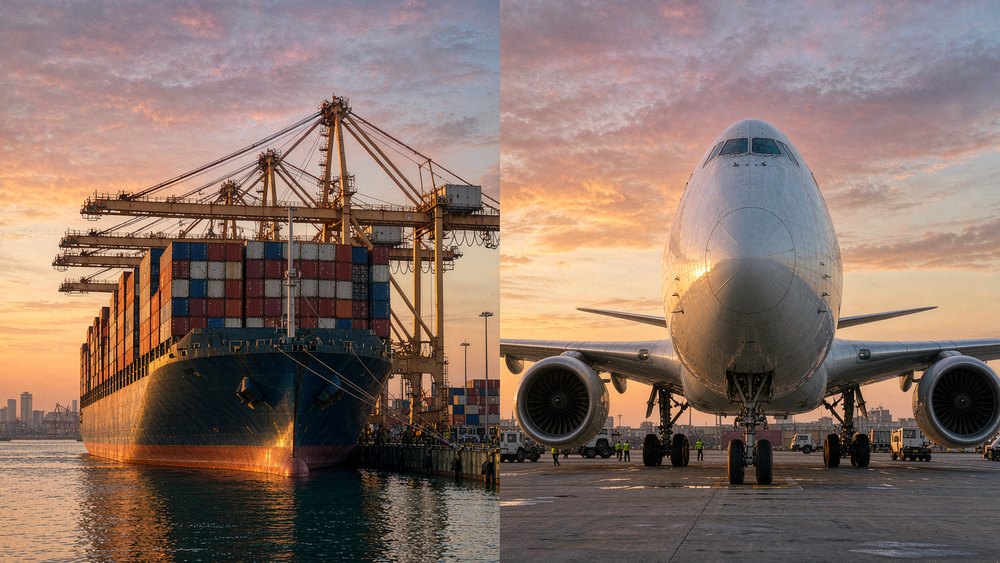
Whether a shipment goes by sea or by air is rarely a question of which is cheaper. It is a question of which suits the order. Choose the wrong mode and the freight saved may not cover the cost of one late delivery; air freight a shipment whose schedule had slack in it and the margin is simply given away. This article covers general decision framework, comparison method and a checklist only; routes, capacity and pricing rest on actual quotations and carrier confirmation.
1. Settle Three Things First: Transit Requirement, Cargo and Deadline Flexibility
Before choosing anything, write three things in a line at the top of the quotation. First, the transit requirement: does the customer need arrival at the port or delivery to their warehouse, and how many days are allowed from factory dispatch to signed receipt? Second, the cargo itself: general or special? How heavy and how large is each piece? Does it contain batteries, liquids or magnets, need temperature control, or fall outside normal dimensions and weights? Third, deadline flexibility: if the shipment arrives three days late, can the customer live with it, and if so, how much slack is there; if not, which milestone is the constraint? Without those three, every later comparison becomes guesswork. The most common rework in practice is quoting before establishing that the customer needs a warehouse arrival rather than a port arrival, so that everything saved at sea is consumed by waiting and delivery at destination.
2. Sea Freight: Where a Full Container Ends and Groupage Begins
Sea freight offers low unit cost and broad coverage, at the price of long transit times tied to sailing schedules. The choice between a full container and groupage turns not on whether the volume would fill a container but on three things. The first is how well the cargo tolerates consolidation and transhipment: groupage means sharing a container with other cargo and additional handling, so fragile, crush-sensitive or space-sensitive goods may not suit it. The second is the relative size of the time cost: groupage waits for cargo to accumulate, for cut-off and for consolidation, usually adding several days over a full container; where the customer is time-sensitive, the saving in freight can be smaller than the cost of the delay. The third is the weight of the consignment: heavy goods moving as groupage are often charged by weight, and the arithmetic may not favour groupage at all. The common misconception is that anything short of a container must be groupage; the better approach is to set out the actual arrival time and the full cost for all three options - full container, groupage and air - before deciding.
3. Air Freight: When It Earns Its Cost
Air freight earns its cost in three situations. The first is a transit requirement that cannot move: a customer’s production line waiting on material, an exhibition or seasonal window already fixed, a stock-out that stops a line or breaks a contract. The second is high value in a small volume, where the higher the value per kilo, the smaller the share freight takes of total cost and the easier the air rate is absorbed. The third is cargo that requires a short journey: temperature-controlled goods, samples and returns where a fast answer matters, and repair parts. Two things also need checking. Capacity and frequency matter, since a direct flight and a transhipment service differ more than people expect, and transhipment adds handling between airports. And the chargeable basis needs to be clear: air freight is charged on chargeable weight, the greater of actual and volumetric weight, so for light bulky cargo the volumetric figure can far exceed the actual weight; work it out before quoting to avoid the gap between an estimate based on actual weight and a settlement based on volumetric weight.
4. Comparing Cost Without Distorting It
Comparing freight rates alone is the commonest source of distortion. Bring the comparison onto one sheet, with at least six lines. The main freight charge. Surcharges of every kind, from fuel and peak-season to security and destination charges. Local charges at both ends, covering collection, loading, export declaration and delivery. Time-related cost, including capital tied up, inventory in transit, and any penalty or compensation a delay could trigger. Handling cost, such as the waiting time in a groupage consolidation, document exchange and devanning. And the cost of uncertainty, covering the chance of being rolled in peak season, and the probability and cost of inspection and storage. Sea freight looks cheap because the first two lines are low; once the fourth and sixth materialise they usually exceed the difference in freight. The reason practitioners say freight is the small number and time is the large one is precisely this.
5. Cargo Characteristics and Restrictions: Some Goods Decide for You
What the cargo is often narrows the options before cost is considered. Products containing lithium batteries, samples with liquids or powders, parts with magnetic properties, and raw materials or finished goods needing temperature control generally require additional appraisal, packing or certification, and some carry restrictions on the mode that can be used. Oversized or overweight machinery frequently moves only in special equipment or breakbulk, and handling capacity and route have to be confirmed in advance. Packing is a constraint too: air freight is more sensitive to dimensions and piece weight, while groupage places higher demands on stacking and protection. The sound practice is to describe the cargo at the enquiry stage - composition, battery content, magnetic properties, temperature requirements, piece weight and dimensions - rather than adding the detail at booking or at the warehouse door. There is a second benefit: with the information up front, the carrier can propose a compliant solution rather than refusing the cargo on the day.
6. Peak Season and Securing Capacity
The logic of peak season is that space comes before price. On the sea side, in the traditional peak and the run-up to public holidays, space tightens and schedules congest, raising the chance of being rolled or re-booked; on the air side, capacity is committed early by large shippers and spot booking prices jump. Three things apply to both. Book early, putting the foreseeable shipping plan to the forwarder two to three weeks ahead, which is far steadier than hunting for space at short notice. Keep a buffer, working back from the customer’s deadline with several days of uncertainty built in rather than planning production against ideal sailing and flight times. And prepare an alternative for key orders - the next sailing, a change of mode, or a split shipment - confirming with the customer in advance whether partial arrival is acceptable. The real peak-season risk is not the price rise but having nowhere to book while there is no time left to warn the customer.
7. A Mixed Approach: Sea on the Main Volume, Air for Replenishment
Many exporters in practice mix the two: the bulk moves by sea to hold cost down, while urgent pieces and replenishment go by air or international courier. Making that work depends on drawing an executable line for what justifies air, and three tests are commonly used. The risk of a stock-out, meaning whether failing to replenish stops the customer’s line. Value per kilo, since beyond a certain level the freight share can be absorbed. And the order rhythm, since where a customer takes delivery in instalments, an early first batch often lets them start work. Once the line is set, write it into the dispatch process: when goods are ready, decide first which items are urgent and arrange them separately, rather than discovering a missing batch after the vessel has sailed. The extra value of mixing is that it turns fast or cheap from an either-or into a combination, buying certainty on the deadline with a controlled amount of freight.
8. Common Misconceptions and a Checklist
Misconception one: comparing freight only, without the cost of time, and losing far more than was saved. Two: reusing the previous mode out of habit without reassessing this shipment’s transit requirement and value. Three: estimating air cost on actual weight for light bulky cargo, so that the quote and the settlement diverge. Four: treating not filling a container as automatically meaning groupage, ignoring time and weight. Five: booking late in peak season with only one plan, leaving no route back if the shipment is rolled. The checklist asks one question against six dimensions: does the customer need port arrival or warehouse delivery, and how many days are allowed; is the cargo a special category with additional appraisal or packing requirements; do piece weight and dimensions exceed limits, and what is the volumetric weight of light bulky cargo; does the value per kilo carry an air rate; is it peak season, and how far ahead must space be booked; and if it arrives late, how long can the customer tolerate, and what is the alternative. Answer those, and the choice usually makes itself.
YINGSHANG Freight Tip: three rules - settle the transit requirement and deadline flexibility before discussing freight, since the other order leads to rework; put sea and air on the same sheet, including surcharges, local charges and the cost of time; and in peak season the priority is booking space early and holding an alternative, not comparing prices at the last minute. YINGSHANG provides Shanghai export booking, customs declaration and international freight forwarding, with international freight forwarding within its registered business scope, and can help set out cargo characteristics, check documentation and give a comparison of transport modes before shipment. Call 189-1692-3020.
Author: YINGSHANG Editorial Team
Reviewed: · Source: Shanghai Yingshang Car Rental Co., Ltd.
The YINGSHANG Editorial Team is the official content team of Shanghai Yingshang Car Rental, responsible for curating international logistics, import customs clearance and supply chain content, and for verifying pricing and reviewing content.
Freight rates, service and process details in this article were reviewed and updated by the YINGSHANG Editorial Team on 2026-10-15. International logistics prices fluctuate with the market and are subject to the day's quote; call 189-1692-3020 for the latest plans and rates.