2026-11-01 · Yangpu shuttle routes
Yangpu: Fixed Shuttle Runs in Wujiaochang and Dalian Road
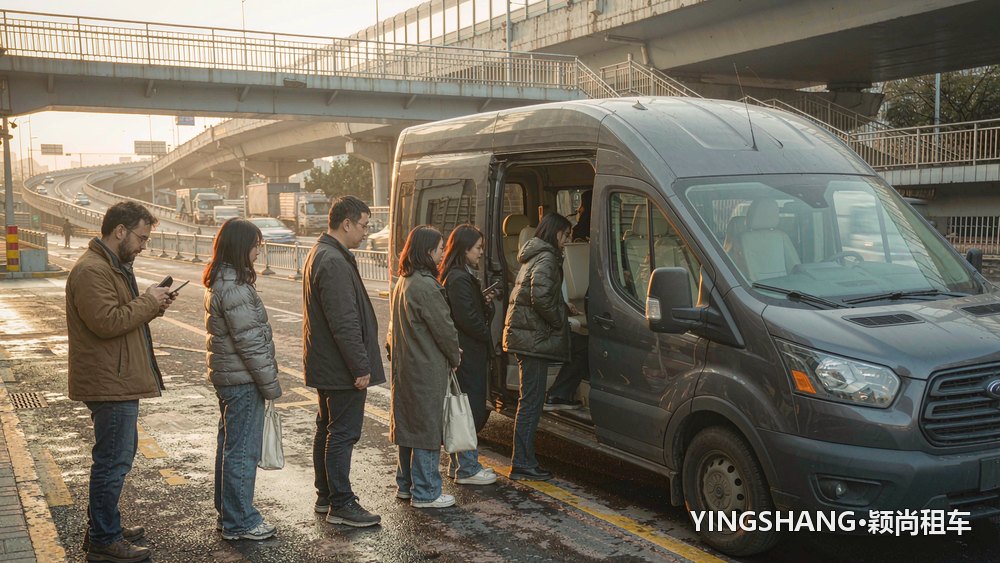
Yangpu has an awkward shape for transport. To the west sits Wujiaochang, where five roads meet at a ring and offices, malls and a metro interchange are stacked on top of each other. Along the south, offices and parks run in a band down Zhoujiazui Road and Dalian Road, one tunnel away from Pudong. In between are the Fudan and Tongji campuses, each producing a rush of people twice a day. Further east, five and a half kilometres of former industrial waterfront has become public space. Corporate transport here is rarely a question of whether a vehicle exists; it is a question of how a route becomes a timetable, because the same departure time produces two different outcomes depending on whether you cross the ring or the tunnel. This piece follows the clock: what happens in the vehicle between 6:30 and 8:10, how three evening departures are set, the two details that must be arranged in advance, and the route card we use after the first month. District coverage is on our Yangpu corporate transport page, the shuttle format on our employee shuttle service page, and seat classes across the 22 models on our corporate vehicle pages.
1. Three maps inside one district
Q1: Which three areas need separate routing, and why can they not share one table?
The west is the Wujiaochang ring: Shenhu Road, Handan Road, Siping Road, Huangxing Road and Xiangyin Road converge there, with offices, retail and a metro interchange in the same block. In peak hours one lap of the ring can take a quarter of an hour, so drop-offs belong on the outer edges — driving in to collect someone is self-inflicted delay. The south is the park band along Zhoujiazui and Dalian Road: few north-south links, and the crossing to Pudong depends on the Dalian Road tunnel, whose queue has to be budgeted rather than hoped away. The east is the waterfront and Gongqing Forest Park: wide roads, light traffic, but event-driven demand — team days, open days, family days — where mid-size and large coaches do most of the work. A single timetable across all three will fail, because the ring and the tunnel need different margins; run the ring on tunnel timings and you arrive early and idle, run the tunnel on ring timings and you arrive late. Set a base time per area, then add a buffer only on segments that cross between them. In practice the first question we ask a Yangpu client is which three directions staff live in, because the answer usually settles how many areas the routes need.
2. A fixed route is designed backwards
Q2: How is a fixed route designed? Addresses, interchange points, a detour factor
Three steps. Collect where people start: not "which district do you live in" but "which metro station is convenient in the morning", because staff judge a station more accurately than their own compass bearing and a station is a natural meeting point. Then set the stops: string the named stations into a route of four to six pickup points. Beyond six, whoever boards last waits more than twenty minutes and that route loses passengers. Then apply a detour factor: multiply straight-line distance by 1.35 to estimate real distance in city peak traffic, which is a workable approximation, and add five to eight minutes separately for any segment crossing the tunnel or the ring. Finish with one calculation: work the departure time forward through each stop and look at the spread between first and last pickup. More than forty minutes means the route is too long — split it, or hand the far end to the metro with a short feeder run. This looks like over-analysis and it is exactly what determines whether anyone is still on the vehicle in three months. Once the stops are set, publish them in the staff handbook and leave them alone; every change loses somebody.
3. The morning timeline, 06:30 to 08:10
Q3: What is actually happening in the vehicle between 6:30 and 8:10?
At 06:30 the driver walks the vehicle: tyres, lights, glass, then seats, belts and air conditioning inside. That is the standard pre-departure check, not an extra. At 06:45 the vehicle is at the first stop, fifteen minutes early, to absorb traffic lights and find a legal stopping position. At 07:00 it departs, with a three-minute grace — time for the person who has seen the vehicle and is still crossing the road. Past three minutes it goes, otherwise every downstream stop slips in sequence. Between 07:15 and 07:35 it works through three or four intermediate stops at ninety seconds each, with the driver ticking names on a list rather than counting heads, because counting misses whoever has just stepped on. At 07:40 it reaches the outer edge of Wujiaochang, where the ring is now congested; passengers walk three to five minutes into their buildings, which is faster than queueing inside the ring. At 08:00 it reaches the park gate, where staff badge in and visitors have their plates checked. At 08:10 the vehicle is back at base and the driver resets the cabin — rubbish out, seats straight, umbrellas and tissues restocked — because it goes out again in the afternoon. Once this timeline is fixed, print it and put it in the vehicle: it answers in one page what the group chat answers badly a hundred times.
4. Three evening departures and the overtime run
Q4: How are the evening runs set, and who is each one for?
The 17:30 run serves standard hours. Most park roles finish then, so the stop sits just outside the main gate and two vehicles depart together, which stops one filling while the other runs empty. The 18:30 run serves flexible schedules and anyone staying an extra hour: fewer people, so a seven-seater or a 17-seat minibus is usually enough, but keep the mechanism for upgrading — check bookings an hour ahead and if they pass eighty per cent of seats, change the vehicle before departure rather than leaving people on the kerb. The 21:00 run serves overtime and late shifts, and is the hardest of the three: few passengers, clear roads, but higher driver fatigue, so either rotate two drivers or keep one who lives close by, avoid roadworks and poorly lit side streets, and drop anyone travelling alone at their building entrance rather than the corner of the block. There is also a hidden gap between 19:00 and 20:30, where the number of leavers is neither small nor large: too late for the 18:30, too early for the 21:00. The usual answer is a booking rule — five confirmed passengers by 17:00 and the run operates; below that, a taxi allowance. Writing that rule down is cheaper than adding vehicles on the night and more dignified than telling staff to sort themselves out.
5. Two details arranged in advance: access and clearance
Q5: Why must park access and garage clearance be arranged in advance?
Access first: most offices around Wujiaochang and parks such as Changyang Campus and Innospring require visitor plates to be filed in advance, typically with the property contact by 17:00 the previous working day, and the confirmation screenshot should be kept. An unfiled vehicle is stopped at the barrier, the driver has to reverse out and rejoin the queue, and in the morning peak a single stop costs a quarter of an hour. Then clearance: some older garages sit under two metres, so high-roof models cannot enter and must drop off at street level, where waiting is often restricted — a question to ask property management on the first site visit and to record on the route card. A third detail is the loading position: when staff carry laptops, sample cases or exhibition material, the drop-off needs five minutes of legal standing, otherwise people get out while the boxes stay in the boot and the driver circles the block. None of this is difficult; the difficulty is that nobody asks early. Our practice is a live site run before a route opens, with the driver photographing three positions — the drop-off, an alternative, and the nearest place where five minutes of standing is allowed — all three into the route card, which is then sent to any replacement driver.
6. Reviewing after one month: three numbers and a route card
| Route | Direction served | Pickup points | Vehicle and seats | Arrange in advance |
|---|---|---|---|---|
| West (Wujiaochang ring) | Baoshan and Dabaishu into the ring | 4, mostly metro exits | 7-seat / 17-seat | Outer-edge drop-off, office plate filing |
| South (Dalian Road parks) | Pudong across the tunnel, Zhoujiazui Road | 5, including one park-and-ride | 17-seat / 22-seat | Tunnel peak margin, park access filing |
| North-east (Gongjiang Road to waterfront) | Zhongyuan and Yinhang, plus waterfront offices | 3 | 7-seat / 22-seat | Garage clearance, alternative drop-off |
| Overtime runs (three) | Main park gate, one-way | 1 consolidated point | 7-seat, upgradeable to 17 | Booking count by 17:00, late-night drop-off rule |
| Event transport | Gongqing Forest Park, waterfront venues | Per event | 22-seat / 33-53 seat | Venue parking permits, consolidated drop-off route |
YINGSHANG Car Rental Tip:Search YINGSHANG Car Rental on WeChat or call 133-7002-5039 for a blank copy of the leasing-versus-ride-hailing checklist and the Yangpu route card; visits to our Songjiang yard at 1468 Laiyin Road, or to the dispatch centre at 655 Jiujing Road, can be arranged in advance.
Author: YINGSHANG Editorial Team
Reviewed: · Source: Shanghai Yingshang Car Rental Co., Ltd.
The YINGSHANG Editorial Team is the official content team of Shanghai Yingshang Car Rental, responsible for curating Shanghai charter, chauffeured rental, corporate shuttle and business travel content, and for verifying pricing and reviewing content.
Pricing, vehicle and service details in this article were reviewed and updated by the YINGSHANG Editorial Team on 2026-11-01. Charter prices fluctuate with the market and are subject to the day's quote; call 133-7002-5039 for the latest vehicles and rates.
District Coverage
Corporate shuttle, business car rental and long-term hire in these districts.