📅 2026-11-02 · Pudong Morning Peak
Morning Drop-off in Lujiazui Without Delays: How to Define a Pudong Fleet’s Dispatch Radius
Four out of five transport complaints in Pudong are not about the vehicle. They are about ten minutes. And those ten minutes are rarely on the road: Century Avenue and Gaoke Road are slow but rarely gridlocked. What consumes the time is queueing at the drop-off bay, security checks at the lobby gate, detours around height-restricted car parks, and a driver hesitating over which side of the tower is the right one. None of this appears in a contract, yet it happens daily. Treating the dispatch radius as something measurable is the starting point: not a vague “roughly this far”, but three numbers that can be written into an agreement — one-way minutes, first-stop arrival time, and buffer minutes. This article follows the pitfalls: the three most common mistakes, how to quantify the radius, and three ready-to-copy plans for Lujiazui, Zhangjiang and Jinqiao. Coverage and drop-off conditions in Pudong are described in corporate transport in Pudong, campus shuttle forms in business park shuttle, and vehicle classes in business vehicle fleet.
1. Recognise the bottleneck: time is spent at the door, not on the road
Q1: Where is the real morning bottleneck in Lujiazui, and why can it not be routed around?
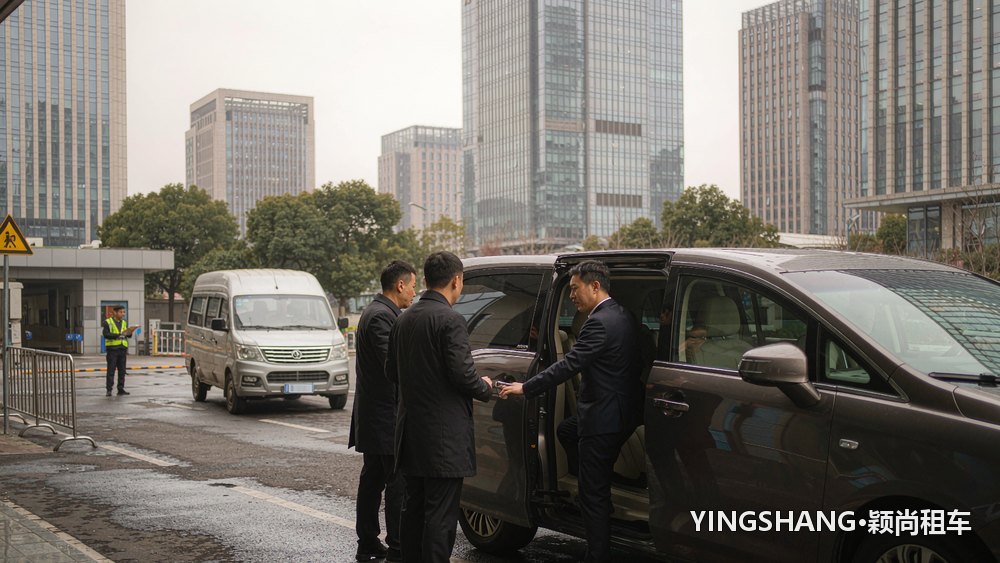
Three points, all within the last three hundred metres. The drop-off bay: most towers have a single lane, so one vehicle lingering two minutes sends the queue into the street, and many buildings require drop-and-go, meaning a driver waved on must circle the block — eight to twelve minutes. The lobby gate: visitor registration, temporary cards and lift marshalling all happen at one entrance, and the vehicle cannot wait. The car park: some basements are limited to about 1.9 metres, so a seven-seat van fits but a high-roof model does not and must use the street-level bay, pushing all the pressure onto the road. These cannot be avoided, only designed in: name the drop-off point down to door number and lane, write drop-and-go plus an agreed holding bay into the contract, and check height limits in advance. Do those three and on-time performance on the same route changes noticeably.
2. Mistake one: “drop at the building” without naming the side
Q2: Why name the door number and lane rather than just the building?
Because a tower has four faces and each behaves differently. In a typical Lujiazui high-rise, the south side is the main entrance with a wide but queueing lane; the north side faces a side street, quick to drop but a two-hundred-metre walk; the east side is the loading dock, closed to stopping after eight; the west side connects to a mall and carries the heaviest footfall. “Drop at the building” sends the driver to the main entrance by navigation, while the north side street is eight minutes faster. Write it as building, door number, lane direction, and whether holding is allowed — for example, drop-off on the north side street, drop-and-go, holding at a public bay two hundred metres east. Add a quarterly check, because renovations, hoarding and security rotations all change the rules. Put it in the contract annex instead of a WeChat message.
3. Mistake two: routing by shortest distance, ignoring tunnels and restrictions
Q3: What is most often overlooked when routing across the river?
Two things: peak-hour differences between tunnels and bridges, and time-based restrictions on certain vehicle types. The Yan’an Road and Fuxing Road tunnels, the Nanpu and Lupu bridges all have different morning curves; on the same river the wrong choice costs fifteen to twenty minutes, and a tunnel incident takes far longer to clear than a surface road. The second is restrictions: some tunnels and elevated roads limit specific vehicle types and hours, and a large coach does not share the same conditions as a seven-seat van, so check by vehicle class instead of assuming. In practice, treat the crossing as an independent variable in the plan: primary tunnel in the morning peak, alternative, and the diversion if there is an incident — all three written down so the driver does not improvise. Add one rule of thumb: buffer for a crossing is a peak buffer, not an off-peak one; twenty-five to thirty minutes is realistic where fifteen is not.
4. Mistake three: one vehicle across two districts
Q4: How far can one vehicle actually cover, and why set a dispatch radius?
Because a vehicle’s day is bracketed by first-stop arrival and last-stop return. A seven-seat van that must reach its first Lujiazui stop at 07:20 leaves the depot at 06:50, finishes three drops by 08:20, returns empty to Zhangjiang by 09:00 — and can do nothing else in between. Scheduling it to continue from Lujiazui to Jinqiao looks efficient, but with the crossing plus drop-off queues the second wave is late every time. So the radius is not geography; it is whether one closed loop fits inside two hours. Beyond that, the vehicle runs one route for the day and a second route will overrun. Rule of thumb: three to four stops with a ninety-minute loop in the city; one stop and a hundred-minute loop across the river; beyond that, split the vehicles rather than chaining districts. Writing this into the plan is more useful than explaining traffic afterwards.
5. Write the dispatch radius as three numbers in the contract
Q5: How do you turn the dispatch radius into three contract numbers?
One-way minutes, first-stop arrival time, buffer minutes. Measure one-way minutes in the peak, not from navigation off-peak, using the median of the last two weeks of trip records at the same hour, and write “not exceeding X minutes”. Write first-stop arrival as a clock time rather than a range — at the first stop by 07:20 on workdays, with more than ten minutes counting as late. Write the buffer explicitly: no more than three minutes dwell per stop, fifteen minutes of buffer across the route, overtime charged once the buffer is consumed. Add two clauses: replacement vehicle within a stated time (forty minutes in the city is common), and how lateness is counted and handled. Once these sit in the annex, dispatch has a basis: drivers know the pace, admins know how long to wait, and suppliers know which step breaches the agreement.
6. Ready-to-copy plans for Lujiazui, Zhangjiang and Jinqiao
Q6: How should Lujiazui, Zhangjiang and Jinqiao each be planned?
Lujiazui is about drop-off, Zhangjiang about radius, Jinqiao about waves. Lujiazui: short routes with dense stops, three to four per route, seven-seat vans, drop-off points named to door and lane, and one on-site coordinator at the main entrance during the peak. Zhangjiang: a large campus with scattered companies, so one route serving two companies with a loop under a hundred minutes, split beyond that; register plates and passenger lists with campus security in advance or the vehicle is refused entry. Jinqiao: manufacturing and R&D with shift patterns, so waves matter more than routes — morning pick-up, evening drop-off and one overtime run, mid-size coaches mixed with vans, and the overtime response time written into the contract (requested by 16:00, on site within two hours). All three share one requirement: the plan states first-stop arrival time, dwell limit per stop and buffer minutes. Without those three, a plan is only a map. Match vehicles to headcount at about eighty per cent load; a range of 22 models from 7 to 53 seats covers most corporate routes.
| District | Main constraint | Route design | Vehicle class | Must be in the plan |
|---|---|---|---|---|
| Lujiazui | Drop-off bay and lobby queues | One stop, or three to four dense stops within 90 minutes | Seven-seat business van | Door number, lane direction, holding rule |
| Zhangjiang | Large campus, scattered stops, gate control | Two companies per route, loop under 100 minutes | Seven-seat van / mid-size coach | Plate and passenger registration list |
| Jinqiao | Shifts, dense waves | Morning pick-up, evening drop-off, one overtime run | Coach and van mix | Overtime response time and arrival |
💡 YINGSHANG Car Rental Tip:Name the door, not the building; buffer for the peak, not the off-peak; split vehicles rather than chaining districts. Search YINGSHANG on WeChat or call 133-7002-5039 for blank samples of the annual-event fleet sizing sheet and the morning-peak dispatch plan. Buyers in Shanghai are welcome to inspect vehicles at 1468 Laiyin Road, Songjiang, or see how dispatch boards and trip sheets are kept at the Jiujing Road control centre.